Monday, September 30, 2013

Journalists Re-fight Old Battles; Expose Recurring Wrongs

Dissident journalists of the past exposed many social problems (like the labor weeklies spotlighting the problem of people being jailed simply for being in debt) and brought about reform.  But other journalists --  years or generations later -- may have to keep exposing the issue . . . as these investigative journalists for the big mainstream daily in Minneapolis recently did.
"It's not a crime to owe money, and debtors' prisons were abolished in the United States in the 19th century. But people are routinely being thrown in jail for failing to pay debts. In Minnesota, which has some of the most creditor-friendly laws in the country, the use of arrest warrants against debtors has jumped 60 percent over the past four years, with 845 cases in 2009, a Star Tribune analysis of state court data has found."
I.F. Stone pointed out that some reforms don't happen except through the work of generations of journalists and democracy activists:
“The only kinds of fights worth fighting are those you are going to lose, because somebody has to fight them and lose and lose and lose until someday, somebody who believes as you do wins. In order for somebody to win an important, major fight 100 years hence, a lot of other people have got to be willing - for the sheer fun and joy of it - to go right ahead and fight, knowing you're going to lose. You mustn't feel like a martyr. You've got to enjoy it.”

Early Dissident Newspapers -- Not Very Reader-Friendly

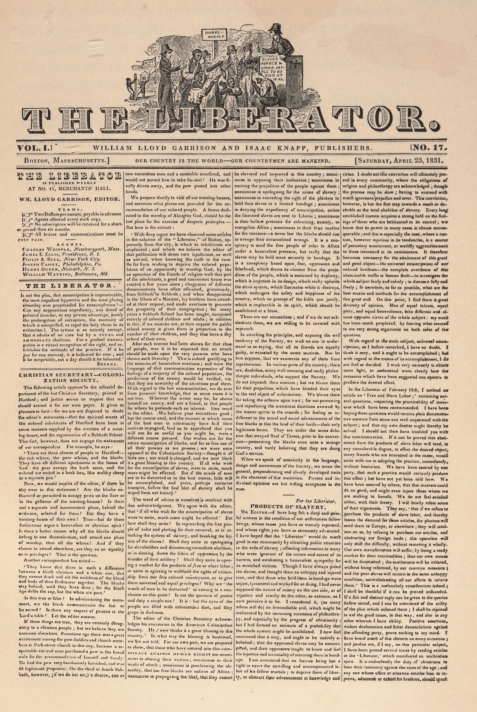
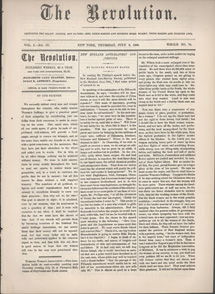
See crowded layout of William Lloyd Garrison's abolitionist publication, The Liberator, here and here. Not exactly HuffingtonPost. No half-naked actresses. Cady Stanton's/Anthony's feminist publication, The Revolution, was almost as dense.  Content was king (or queen) back then.

Wednesday, September 25, 2013

AOL's Journalistic Values

Soon after AOL announced its merger with HuffingtonPost in February, 2011 the Boston Globe published leaked AOL documents offering a glimpse into that company's journalistic approach -- not one that Arianna Huffington would endorse. (H/t to former indy media student Leah T, for summarizing the Globe piece.)

Internet Hoaxes

Question: Are younger educated people who were raised on the Internet LESS likely to be taken in by hoax emails such as Obama as "radical Muslim" than Jon Stewart's 80-year-old aunt? Or clothing designer Tommy Hilfiger as racist?

Today, viral video hoaxes seem more common than text hoaxes -- like "Golden Eagle Snatches Kid" hoax, that unknown to this ABC News panel, was perpetrated by animation students using computer imaging in Montreal. And like "Worst Twerk Fail EVER - Girl Catches Fire," a hoax perpetrated by the Jimmy Kimmel show as self-promotion.

UPDATE: NBC "Today" show interviewed me yesterday (Sept. 30 -- my bit starts at 2:25) about separating fact from fiction in media and Internet.


Tuesday, September 24, 2013

Another journalism source pleads guilty


After combing through weeks of phone records (multiple phones) of Associated Press journalists, the Obama Justice Department was able to identify and prosecute AP's source on a story about a terrorist plot in Yemen.  The source, a former FBI agent, pled guilty yesterday. This is from Agence France-Presse:
Although Obama had promised openness when he entered office, his administration has pursued an unprecedented crackdown on leaks from government employees, attempting more prosecutions under the 1917 Espionage Act than all previous administrations. A US Army private, Bradley Manning, was sentenced to 35 years in prison in August for passing a trove of classified documents to the anti-secrecy website WikiLeaks. Manning's supporters defended him as a whistleblower trying to shed light on US wars and secret foreign policy making but prosecutors called the soldier a "traitor."

John Kiriakou, a former Central Intelligence Agency officer, was charged with leaking secrets after he gave an interview to ABC television describing the use of water boarding in interrogations of terror suspects under the Bush administration. He pleaded guilty in 2012 to disclosing the name of a covert CIA officer and was sentenced to two and a half years in prison. Monday's plea agreement serves as a warning to intelligence leaker Edward Snowden, who has been charged with espionage and condemned for his dramatic disclosures on US electronic surveillance.

Friday, September 20, 2013

"Miss Representation" is a 2011 documentary about sexism in media.

The trailer for the doc is here.  (At 2:35, we see glimpses of female Fox News talking heads in business attire.)

Is U.S. media system failing U.S. democracy?

A 2008 academic study compared the level of public knowledge about current events in Denmark, Finland, England and the U.S. It found that the countries where TV/radio is dominated by public broadcasting -- Denmark and Finland -- were the best informed. Our country, dominated by corporate commercial media, was the least informed. The study's authors suggest that differing media systems play a role in those results.

A 2003 study of U.S. public knowledge of facts related to the Iraq War found that misperceptions were greatest among those whose primary info source was Fox News -- and least among those whose primary info source was public broadcasting. (A Pew poll taken in Aug. 2010 found that almost 1 in 5 Americans believed President Obama to be a Muslim; only 34% knew he is a Christian. 43% chose "don't know.")